
What Is Blockchain Technology? How It Works, Benefits & Real-World Applications
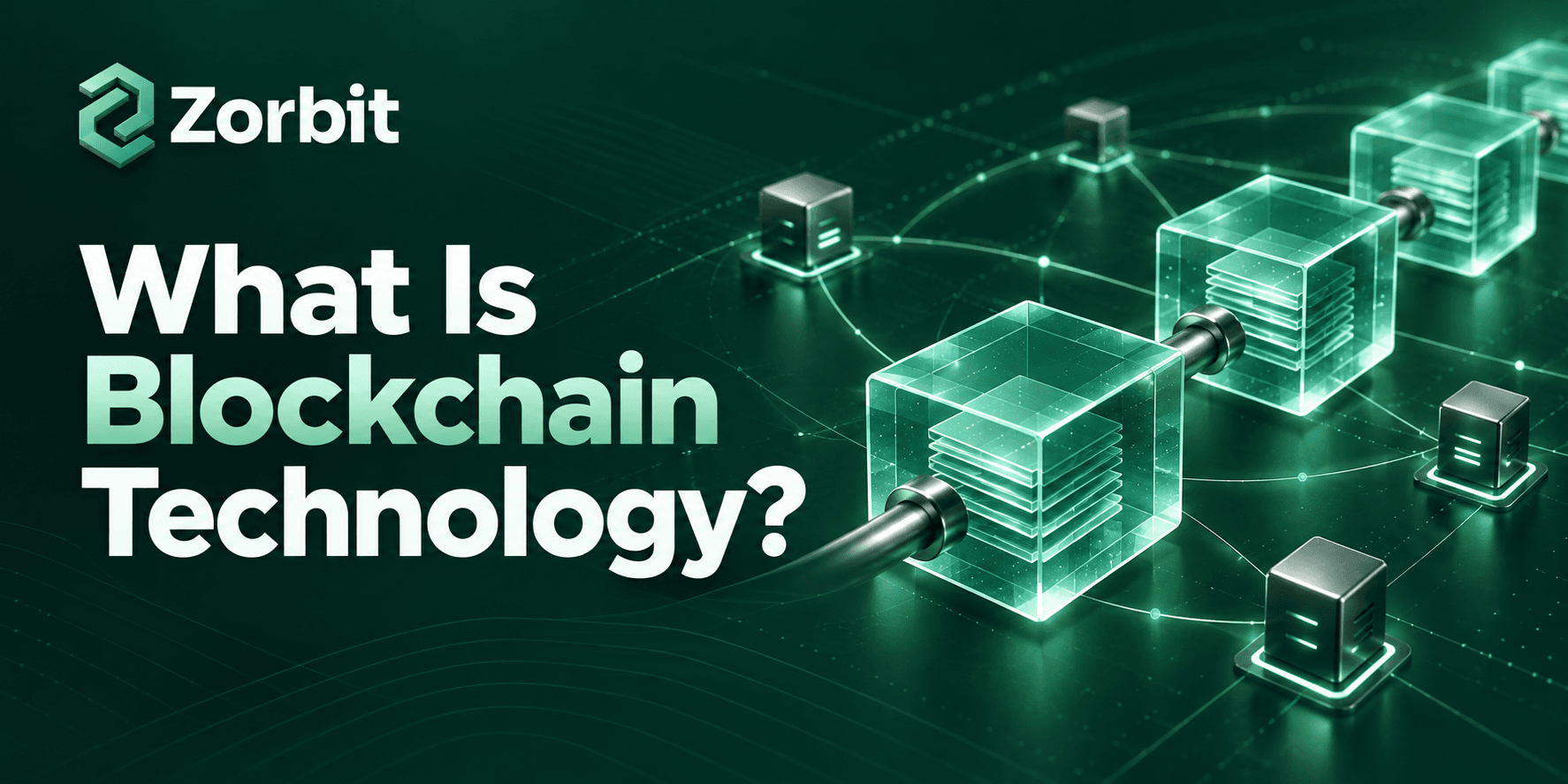
Blockchain technology has become one of the most important innovations in digital finance, powering cryptocurrencies, stablecoins, decentralized applications, and new financial infrastructure.
From Bitcoin transactions to institutional digital asset trading, blockchain is changing how businesses transfer value, verify transactions, and manage digital assets.
In this guide, we'll explain what blockchain technology is, how it works, its benefits, and its role in the growing global digital asset ecosystem.
What Is Blockchain Technology?
Blockchain is a distributed digital ledger that records transactions across a network of computers.
Unlike traditional databases managed by a central authority, blockchain networks can distribute transaction records among multiple participants, improving transparency and making records difficult to modify.
Each block contains transaction information and is cryptographically linked to the previous block, creating a continuous chain of records.
Example: When a business transfers USDT or USDC using a supported blockchain network, the transaction is validated and recorded on that network, allowing participants to verify its status.
How Does Blockchain Technology Work?
Blockchain technology generally operates through five steps:
Transaction initiation: A user initiates a cryptocurrency or digital asset transaction.
Network validation: Network participants verify the transaction according to the blockchain's rules.
Block creation: Validated transactions are grouped into blocks.
Consensus: The network uses a consensus mechanism to agree on valid transaction records.
Transaction confirmation: The transaction becomes part of the blockchain's shared ledger.
Different blockchain networks use different consensus mechanisms, confirmation processes, and transaction fee structures.
Types of Blockchain Technology
Blockchain Type | Description |
Public Blockchain | Open networks such as Bitcoin and Ethereum that allow public participation. |
Private Blockchain | Permissioned networks controlled by a single organization. |
Consortium Blockchain | Networks governed by a group of participating organizations. |
Hybrid Blockchain | Combines public and private blockchain features. |
Public blockchains are widely used for cryptocurrencies and stablecoins, while permissioned networks are also explored for enterprise and financial applications.
Key Benefits of Blockchain Technology
1. Transparency
Public blockchains provide accessible transaction records that can be independently verified.
2. Security
Cryptography and consensus mechanisms help protect blockchain records from unauthorized modifications.
3. Global Accessibility
Blockchain networks allow supported digital assets to be transferred between compatible wallets across different locations, subject to network availability and applicable restrictions.
4. Operational Efficiency
Blockchain-based transactions can reduce reliance on certain intermediaries and simplify some financial workflows.
5. Traceability
Recorded transactions provide an auditable history that can support monitoring, reconciliation, and financial reporting.
Real-World Applications of Blockchain
Blockchain technology supports several use cases across the global economy.
Cryptocurrencies: Bitcoin and Ethereum use blockchain networks to support digital asset ownership and transfers.
Stablecoins: USDT and USDC use blockchain infrastructure to represent and transfer digital tokens designed to maintain a stable value.
Decentralized Finance: Smart contracts enable financial applications such as lending, borrowing, and decentralized trading.
Asset Tokenization: Blockchain can represent ownership interests or rights associated with real-world assets.
Institutional Digital Asset Trading: Blockchain networks support the custody and transfer of assets traded by institutions and professional counterparties.
How Blockchain Powers Stablecoins and Global Digital Asset Markets
One of blockchain's most significant financial applications is the growth of stablecoins.
Stablecoins such as USDT and USDC are designed to maintain a relatively stable value, typically referenced to the US dollar.
They are increasingly relevant to digital asset markets because they can support trading, treasury operations, and blockchain-based asset transfers.
For businesses and institutional counterparties, stablecoins can provide a practical bridge between fiat currencies and digital assets.
However, converting fiat currencies such as USD or AED into stablecoins requires access to appropriate trading infrastructure and liquidity providers.
This is where institutional cryptocurrency OTC desks play an important role.
The Role of OTC Trading in Blockchain-Based Finance
As digital asset markets evolve, businesses increasingly require infrastructure to execute large-volume cryptocurrency transactions.
Crypto OTC (Over-the-Counter) trading allows eligible counterparties to buy or sell cryptocurrencies through a negotiated transaction rather than relying exclusively on the visible order book of a public exchange.
OTC trading can be particularly relevant for:
Virtual Asset Service Providers (VASPs)
Proprietary trading and arbitrage firms
Web3 companies and cryptocurrency platforms
Funds and institutional investors
Corporate treasury teams managing digital assets
For these participants, competitive pricing, transaction size, liquidity availability, and operational reliability are important considerations.
How Zorbit Supports Institutional Digital Asset Trading
Zorbit provides global liquidity infrastructure for institutional counterparties participating in cryptocurrency and stablecoin markets.
Through its OTC desk, Zorbit supports eligible businesses with large-volume and recurring digital asset trading requirements.
Its offering includes:
Institutional OTC Liquidity
Access OTC trading for supported digital assets, including USDT, USDC, BTC, and ETH.
USD and AED Trading Pairs
Zorbit supports fiat-to-crypto and crypto-to-fiat trading requirements involving USD and AED in its supported markets.
Stablecoin On-Ramp and Off-Ramp
Infrastructure to support eligible businesses converting between fiat currencies and supported stablecoins.
Institutional Counterparties
Zorbit works with VASPs, trading firms, Web3 companies, funds, and treasury teams seeking cryptocurrency liquidity.
With an initial focus on the UAE and USA, Zorbit aims to support the growing demand for institutional digital asset trading infrastructure.
Frequently Asked Questions
1. What is blockchain technology in simple terms?
Blockchain is a digital recordkeeping system that stores and verifies transactions across a network of computers.
2. Is blockchain the same as cryptocurrency?
No. Blockchain is the underlying technology, while cryptocurrencies are digital assets that operate using blockchain networks.
3. How does blockchain support stablecoins?
Blockchain allows stablecoins such as USDT and USDC to be issued, transferred, and recorded on supported networks.
4. Why is blockchain important for institutional crypto trading?
Blockchain enables the ownership, verification, and transfer of digital assets that institutions trade, hold, and manage.
5. What is the role of an OTC desk in cryptocurrency trading?
An OTC desk facilitates negotiated cryptocurrency transactions, often serving counterparties with larger or recurring trading requirements.
6. How can businesses trade stablecoins against USD or AED?
Eligible businesses can work with institutional OTC providers such as Zorbit to explore supported fiat-to-stablecoin and stablecoin-to-fiat trading requirements.
Conclusion
Blockchain technology is a foundational component of the digital asset economy, supporting cryptocurrencies, stablecoins, decentralized applications, and institutional financial infrastructure.
As adoption develops across the UAE, USA, and other global markets, businesses need reliable access to digital asset liquidity and trading services.
Understanding blockchain is an important first step toward navigating this evolving financial ecosystem.
Explore Institutional OTC Trading with Zorbit
Looking to buy or sell USDT, USDC, BTC, or ETH against USD or AED?
Zorbit supports institutional counterparties with OTC liquidity and fiat-to-crypto trading infrastructure.
Explore Zorbit's OTC Desk: zorbit.global/otc